
River Trash Collection Systems
Wallace Venable
Technical Coordinator
Upper Monongahela River Association
Upper Monongahela River Association (UMRA) periodically hears suggestions that a floating trash collection system could relatively easily be installed above the Morgantown dam to eliminate the eyesore accumulation of bottles and other refuse visible from the Wharf District. Usually these suggestions are based on successful installations such as those installed at the Baltimore Harbor or those like the ones produced by Stormwater Systems.
All successful systems are designed to fit specific situations and requirements. To understand why these proposals are not a good fit for our problem, it is important to understand how our situation is more-or-less unique.
The Baltimore Harbor Trash Wheels
Baltimore Harbor has four Trash Wheels. You can find a map on the Mr. Trash Wheel website https://www.mrtrashwheel.com/ which shows the locations and provides information on each wheel. The individual sites can be studied with Google Maps, and there are ground level photos of most of the sites.
Mr. Trash Wheel is at the mouth of the Jones Falls (river), [39°16’59.7″N 76°36’12.9″W]about 100 feet upstream from the stream mouth. For many miles, most of Jones Falls is covered by the Jones Falls Expressway, and many cross-streets discharge into Jones Falls.
Professor Trash Wheel is at the end of Harris Creek [39.279584N, 76.583376W], which flows beneath the Canton neighborhood before emptying into the harbor. It is moored by very long (perhaps 600 feet) floating booms which terminate at the outfall of a buried stream and collecting street and other runoff. Only about 400 feet of shoreline on Harris Creek is accessible.
Gwynnda, The Good Wheel Of The West, is in the Gwynns Falls stream at Gwynns Falls, Baltimore, MD [39.2693758N, 76.6310156W] under I-95. The stream drains a large mixed use urban area, and at that point the stream is about 150 feet wide. Downstream of the wheel Ridgleys Cove is heavily silted and is no longer used for navigation.
Captain Trash Wheel, the Fehmarn Trash Wheel is at Masonville Cove [39.24552N, 76.59458W], on a small surface stream which drains surface water from I-895, a railroad yard, and an industrial area.
Two of the wheels serve streams which a fully covered, two are open. All of them at one time discharged untreated sewage into Baltimore Harbor. At one time probably all four served as local small boat delivery or fishing boat harbors. None has ever been able to serve ships of any considerable size.
All of the Trash Wheels have booms which extend completely across the stream serviced. None has a provision for the passage of kayaks or other small craft.
A large portion of the material collected by the Trash Wheels originates as highway, street and parking lot trash. It is mostly light weight. For two of the wheels there is very little material of natural origin. For the two wheels serving open waterways, the natural material will seldom include bushes or trees of significant size. Most of the material collected is of local origin.
Baltimore Harbor doesn’t have river currents, just tides and storm flooding of very modest height. The Trash Wheels don’t deal with trash once it reaches the deeper portions of Baltimore Harbor. They don’t “clean Baltimore Harbor,” they keep many thousands of tons of floating trash from entering it.
Baltimore capitalizes on the trash collectors by decorating them and using them in touristpromotion. As far as I know similar wheels haven’t been used outside of Baltimore.
Stormwater Systems Installations
Stormwater Systems has a well illustrated website at https://www.stormwatersystems.com/ Their systems are designed for what I would consider small to shallow mid-sized streams or storm-water run-off channels. They say they offer a “Bandalong Beast Model #922: Specifically designed for larger rivers, it offers comprehensive coverage for high-volume water bodies.” This is not illustrated or detailed online.
The models illustrated are described as “Perfect for smaller rivers and streams, managing water velocities up to 9 feet per second.” (6 mph)
All of the installations observed in photos have booms which extend partially or completely across the stream serviced. None has a provision for the passage of kayaks or other small craft, although in many installation such boats may be portaged over low banks or lifted over the boom by wading crew.
In many installations trash is collected in bags for removal. In others it is collected in floating baskets and typically removed by hand with implements like rakes.
There systems might be very useful in our region in a number of places. I can imagine installing one in Dunkard Creek upstream of Mason-Dixon Park, or in Deckers Creek, but these projects would have no effect on the Morgantown Lock trash.
Morgantown’s “Unique” Situation
There are certainly other places where trash accumulates at places where water flows under a dam. Most hydroelectric power plants do so, as well as many flood control reservoirs. In the 21st Century, Morgantown has chosen to build expensive high rise structures and recreational facilities overlooking a lock and dam designed and constructed about 1950.
The problem is an aesthetic one, there is no evidence that the trash is particularly hazardous to health or safety.
If you have not done so, you can study the aerial view of the area to be protected. See https://www.google.com/maps/place/Morgantown+Lock+and+Dam,+Morgantown,+WV+26501/@39.6184152,-79.9706949,565m/data=!3m2!1e3!4b1!4m6!3m5!1s0x88357c633643e2a1:0x8c98f603dcc75df0!8m2!3d39.6184152!4d-79.96812!16s%2Fm%2F04045x4?entry=ttu&g_ep=EgoyMDI1MTAwNi4wIKXMDSoASAFQAw%3D%3D
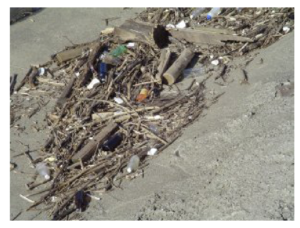
The river flow is from south to north (bottom to top). The brown patch below the dam’s operating spillway is the trash field at the time the photo was taken.
At Morgantown the largest amounts of trash arrive during high water (flood) conditions. Little of the trash originates within Monongalia County, and some may come from over 100 miles away. The rain collection basin upstream includes hundreds of square miles.
It’s hard to see how any of the proposed sorts of machine would deal with a breakaway barge in flood conditions, even the Tainter Gates at Mon River Corps dams have trouble with those.
Although the most offensive trash is mostly plastic bottles, it also includes 50 gallon barrels and car and truck tires. If the Corps accepts river trash, it is required by statute to consider it all as hazardous waste which must be shipped at considerable to somewhere in the distant west.
The tires are a bit of a challenge. As I understand it, those don’t get collected by Baltimore’s wheels, although variations of the Stormwater designs do.
Complicating the idea of automated trash collection is the fact that some of the material swept by a boom is actually part of the natural river cycle. This material should be separated from the man-made trash and returned to the river. Some of this is vegetation such as leaves plus brush and large trees which fall into the river as they die. Animal material to be removed includes dead cats, chickens, and cows, while song birds and deer which drown while swimming are part of the aquatic food chain.
For safety reasons the Corps of Engineers will not permit any non-US Government boats within about 100 feet above or below the dam unless operating under contract from the Corps. Volunteers cannot clear the accumulation.
Nothing can permanently span the width of the river, it is a commercial waterway nominally operating 24/7. Most trash collection systems use a boom to gather trash. Along the entire length of the Monongahela, that boom may not be positioned within the navigation channel or in the approaches to a commercial landing or mooring. If a boom sweeps only a portion of the stream, only a portion of the material will be gathered. Generally speaking, most trash movement can be expected to be in the midstream area which is also where the navigation channel is usually placed. On river bends, the maximum flow and water depth may move to the outside of the curve, but in this case both the trash flow and navigation channel will also shift to the outside.
The locks and dams on the Upper Monongahela are not staffed full time, though they are always available to commercial vessels by appointment. When no lockages are scheduled, the dam spillways are remotely operated without notice. The flow is under the control gates, not over a spillway.
A full, movable, trash boom would require provision for 24/7 operation. This need can not be met by a few volunteers.
Any boom would face the possibility of being hit by 1500 ton break-away barges and large trees while the river is flowing at maybe 15 mph currents at flood conditions.
A boom system towed by two boats operating in the pool above the dam could probably be developed. To be effective it would probably need to operate daily and during high flow conditions, so it would not be suitable for amateur operation.
Any vessel servicing the trash collector would have to be operated by a USCG licensed captain if the operator or vessel owner received payment of any sort.
These options would probably require an initial investment of one or two hundred thousand dollars and operating expenses of the same order of magnitude per year to be effective if operated at local or state expense. The US Army Corps of Engineers could relative easily conduct such operations, but this would require that Congress establish a completely new project, and probably an annual appropriation of $500,000 in new funding for operations in addition to the capital costs for boats and shore facilities.
When the Upper Monongahela River Project was established in the 1870s Congress made no consideration of floating bottles or recreational boating. Those aspects were not included in the Authorization bills, so the Pittsburgh District of the US Army Corps of Engineers can not (officially) spend money on related work. To fund either, Congressional action is required and has not been forthcoming.
There is current interest in installing a Trash Wheel system in the Lower Monongahela.
The Pittsburgh Tribune-Review reported on 15 September, 2025 “Two nonprofit organizations, Allegheny CleanWays and Three Rivers Waterkeeper, are working on bringing a “trash wheel” to the Monongahela River near Hazelwood. ……A feasibility study has been completed, and the organizations are approaching foundations in pursuit of the roughly $1 million needed to get the device in the water, Allegheny CleanWays Executive Director Caily Grube said.”
“A feasibility study has been completed” really only means that it could be built and installed without major problems. “CORPS Approval” (not mentioned) might only indicate that it would not create any more problems than a moored barge. Neither would mean that the investment is a good one or that it would remove a significant portion of the river trash. Getting the device in the water is only the first expense. It probably requires an additional expense of $100,000 a year for unloading, sorting, and disposal. Foundations generally do not provide operating expenses. I have found no more recent information. Perhaps the authors of the proposal have realized that a shoreline boom across a tenth of the river’s width can only be expected to collect 10% of the floating trash.
Engineering solutions must be made around local specifics. In my opinion, there is no modest cost solution to Morgantown’s perceived trash problem. A million dollars or two won’t fix it.
Thoughts on the Trash Wheel Site Plan and Trash Wheel Layout for Morgantown- PDF
Comments by Wallace Venable, Chief Technical Officer, UMRA, on proposed floating trash removal plan.
Site Issues
As I understand the plan, you propose to install a wheel on the upstream side of the Morgantown dam above the easternmost Tainter Gate. I believe that this is officially Gate #6.
Rye Development LLC has an active permit for construction of a hydro-power plant just downstream of the same gate. Both you and Rye may be planning on using some of the same space. You are proposing a Dumpster Ramp at the site. Normal river pool elevation here is 814 feet
and the Caperton Rail-Trail has an elevation of about 825 feet. The required lift is at least 10 feet and the horizontal distance is probably less than 25 feet. This makes for a tough dumpster movement. This would have to cross the trail, and would meet with fierce local opposition from trail users.
Your planned site may fall at least partially on Corps of Engineers operational facilities. There is potential conflict with fishing access at the site.
During heavy rains debris is launched toward Morgantown from sites as much as 60 miles
away. Sites include industrial, commercial, residential, forest, and agricultural activities. Some of these still use illegal open dumps. Others are operated with minimal concern for environmental issues.
River Flow Issues
The purposes of the dam are to (1) establish a constant pool level above the dam for barge navigation and (2) to control flow of the water supply to downstream navigation dams reaching down into the Ohio River below Pittsburgh. This is a regional operation, not a local one. The Corps changes gate openings remotely with changing water flow requirements. The dam does not control flooding, but receives flow from large upstream flood control reservoirs. During the summer there may be virtually no river current while during flood runoff the river current may exceed 5 mph.


During the planning for the Rye plant massive amounts of flow information were gathered, and may be available to you from either Rye or the Pittsburgh District Corps office.
Operational Issues
River Flow
As I see it, your wheel must handle all trash which is intercepted by the boom. Much of this is an easy matter, but there are also many items which pose potential difficulties.
If construction of the Rye power-plant does proceed, it is likely that all flow through Gate 6 may be shut off for periods of weeks at a time. There also may be shutoffs for maintenance if the plant is built. During flood flows very high currents must be expected. Rye will, of course, urge the Corps to maintain high flows to maximize power generation.
Natural Debris in the River
Much of what is visible on the river is not trash, but part of the natural aquatic environment. These items should, or perhaps must, be returned to the river downstream of the dam according to WV DNR policy. Specifically the facility must be prepared to handle and transfer:
- Brush of all sorts eroded from the bank as well as whole trees which have fallen from the riverbank, some of which may have trunks exceed 12 inches in diameter and lengths of 50 feet.
- Animal remains which will occasional include deer carcasses and fish up to 25 pounds in weight.Trash RemovalMuch of the trash is light debris like water bottles and food containers which your wheel can easily handle. On the other hand, significant amounts are materials which pose operational challenges of various sorts. Specifically, based on personal observations, the facility must be prepared to handle and remove:
- Dead domestic animals
- Landscaping debris
- Christmas trees and pumpkins
- Car and truck tires, both loose and on steel rims
- Propane cylinders, in both 1 and 19 pound sizes
- Old boats, boat docks and remains including metal and plastic barrels and Styrofoam billets
- Half filled barrels containing potentially hazardous wastes
- Paint, roofing, and solvent containers containing residues
- Waterlogged mattress and bedding
- Old portable fuel containers of all sizes
- Old life jackets
- Old sheds and debris from damaged buildingsYour machine is an excellent solution to the Jones Falls River trash problems. To adapt it to the Monongahela River is definitely a challenge.Sincerely,
Wallace Venable
River trash and debris, consisting of man-made rubbish and naturally-occurring items such as wood wastes, deposits on river banks and at riverside facilities, and accumulates behind locks and dams. The US Army Corps of Engineers has no facilities for collection and disposal of this trash, so they periodically flush it downstream. It eventually sinks, rots, or ends up in the oceans.
Locally the trash creates many problems, including:
Visual and odor pollution;
Water pollution, hazardous to humans and aquatic life, from chemicals and hazardous materials in man-made rubbish;
Health and safety hazards, for community and industrial water intakes, swimmers, water skiers, marinas, public and private docks and launching ramps, and recreational boaters and river commerce;
Navigation hazards, for commercial and recreational boaters;
Interference with, and damage to, locks and dams.
The US Environmental Protection Agency has an on-line report pertinent to the floating trash and debris problem. It is Marine Debris Abatement at http://www.epa.gov/owow/oceans/debris/
The trash which accumulates behind the Morgantown Dam has been a public irritation for many years. As the development of trails, hotels, and other amenities along the river bank has accelerated, so has a public sense of outrage. UMRA is joining with local groups to search for a solution to this problem.
For several years Tim Terman has run a trash removal effort using kayaks and a pontoon boat with volunteers ranging from children to adults. Tim was selected as one of the Dominion Post ‘s100 Most Influential Citizens in 2008 in recognition of his efforts. Tim has proposed installing a trash boom at the Hildebrand Dam to reduce the amopunt of trash reaching Morgantown. You can read his proposal.
Dams are not all alike, even on the navigable portions of the rivers of the Pittsburgh District. The water flows under our dam. This is why floating trash accumulates so readily behind it. On many dams, water flow is over the dam, and most floating material passes without major impediment.
It is not unfair to say “the Corps created our trash problem” as a part of solving other river problems. Of course, in the 1950s there were few plastic products and many containers were returned for refilling. The current problem was not foreseen.
Community Concern about Floating Trash
Resolution on Floating Trash by the City of Morgantown
Resolution on Floating Trash by the City of Westover
Resolution on Floating Trash by the Town of Star City
Resolution on Floating Trash by the Monongalia County Development Authority
Resolution on Floating Trash by the Monongalia County Commission
A Sample Resolution on Floating Trash
Meeting – Monongalia County Solid Waste Authority – 20 November 2003
News about Floating trash
Port of Houston Receives Award from AAPA for Floating Trash Skimming Program – United Marine International PRESS RELEASE – 14 May 2004
Letter To Editor – Dam Trash: Let’s Clean Up the Mon River Soon – Morgantown Dominion Post – 13 May 2004
Commissioners Try to Slow Spread of Trash: Anti-Littering Signs are one Proposed Solution to Persistent Problem Along Mon River – Morgantown Dominion Post – 29 April 2004
Meeting Weighs Anchor on Trash: Mixed Results Emerge from Session on Debris in River and Behind Dam – Editorial Morgantown Dominion Post – 29 April 2004
Meeting Focuses on River Trash – Morgantown Dominion Post – 26 April 2004
Area Officials Continue to Talk Trash – Morgantown Dominion Post – 22 April 2004
Kids Discuss Trash with Mayor – Morgantown Dominion Post – April 7, 2004
Trash Talk Continues in Commission – Morgantown Dominion Post – April 8, 2004
Letter To Editor – Local Resident Tired Of Garbage Along River – Morgantown Dominion Post – April 12, 2004
All Dams on River Are Not Equal: Design of Local Facility Causes Part of the Built Up Debris Field – Morgabtown Dominion Post – March 27, 2004
That Dam Trash: Pileup of Debris in the Monongahela an Eyesore – Morgantown Dominion Post – March 23, 2004
Debris Threatens Recreation Site – The Charleston Gazette – January 24, 2004
Officials Hope for River Debris Solution – Morgantown Dominion Post – November 10, 2003
Monongalia Officials Seek Federal Help to Remove Debris Behind Locks – The Charleston Gazette – November 10, 2003
Morgantown Council Looks For River Trash Resolution – Morgantown Dominion Post – November 4, 2003
County Joins In River Cleanup – Signs Onto Resolution – Morgantown Dominion Post – October 16, 2003
County Buys New Recycling Baler: Resolves To Clean Trash Behind Locks – Morgantown Dominion Post – October 10, 2003
Development Authority Considers Cleanup Of Lock-And-Dam Trash – Morgantown Dominion Post – October 9, 2003
 Our Search for a Solution
The Nature of the Trash
There is little hard data on the trash involved, but we know that it has the following characteristics:
Material such as leaves, branches, and trees ends up in the river as a result of natural processes. From an environmental perspective, this material is part of the food chain for river life. Although large logs may be a hazard to navigation, they provide important fish habitat.
Organic material from timber and landscaping operations, and construction debris, also finds its way into the river. It is unclear whether this constitutes an additional resource or a problem.
Much of the most visible trash consists of light plastic items such as bottles, balls, and styrofoam. We do not know how much of this is the result of intentional dumping (point sources), and how much results from simple littering and wind and flood dispersal of materials (non-point sources.)
Large containers like barrels may be escaped dock flotation, wind and flood dispersed material, or possibly intentional disposal of hazardous wastes. *
We have suggested that an initial phase of a search for a solution should include a study of trash characteristics, possibly based on video surveillance at the dams. A video surveillance program might make be included in a system which also serves other security needs.
* Barrels are an interesting sub-category. Most are empty and benign. Because they are potentially very hazardous, the US Coast Guard instructs its Auxiliary patrols not to touch them, but to inform relevant local authorities of their presence. In most areas such local authorities do not have the training or equipment required to deal with them.
Novel Boats That Remove Trash And Debris From Waterways
There are boats designed to remove floating trash and debris. As far as we can tell, none of these has been used in turbulent waters typical of those near our navigation locks. Our preliminary estimate is that such a bout would involve an initial investment of a quarter to half a million dollars in the boat and support facilities, and an operating cost of about a hundred thousand dollars a year.
Check out these websites:
Trash Cat at http://www.trashskimmer.com
Trash Hunter at http://www.aquarius-systems.com
Liverpool Water Witch at http://www.waterwitch.com
Hydro-Skimmer at http://www.alphaboats.com
Corps of Engineers Huntington District Debris Control Efforts
The U.S. Army Corps of Engineers Huntington District has been a leader in the study of the trash problem. We have recently received a copy of the Bluestone Drift and Debris Evaluation Study published in December 1996. It includes about 200 pages, which we are still reviewing. Bluestone Lake is of economic concern because a high precentage of West Virginia’s whitewater rafting business is conducted on the waters down stream.
Congress directed the Secretary of Defense “to take such measures as are technologically feasible to prohibit the release of drift and debris into waters downstream of the project, except for that organic matter necessary to maintain and enhance the biological resources of such waters and such nonobtrusive items of debris as may not be economically feasibile to prevent being released through such project, including measures to prevent the accumulation of drift and debris at the project, the collection and removal of drift and debris on the segment of the New River upstream of the project, and the removal (through use of temporary or permanent systems) and disposal of accumulated drift and debris at Bluestone Dam. “
This evaluation study addresses the potential for modification of the Bluestone Lake project. For the purposes of the report, drift is defined as natural, woody material, and debris is defined as man-made refuse. Both can be found floating down the New River, most notably during flood events. The legislation concerns the handling of this drift and debris at the Bluestone project and the development of technologically feasible measures to address the problems associated with drift and debris management at the project. An initial review conducted as a part of this study has found that the primary source of the drift and debris management problems at Bluestone are due to a change of operating pool levels during project construction 52 years ago and the continuing placement of solid waste within the floodway of streams by residents of the region. The interim drift and debris management technique adopted for the Bluestone project 52 years ago has proved to be a long-term operating plan, but it is no longer acceptable because of changed perceptions and conditions in the region.
The project includes a multi-level intake tower and tunnel to permit drift and debris to pass as it reaches the dam, rather than the current operating procedure of releasing accumulated drift and debris at summer pool. Low flows at summer pool cause drift and debris to accumulate just downstream of the dam and in some areas of the New River Gorge National River, particularly above Sandstone Falls. The structural modifications will facilitate downstream material progression during higher flows. Scheduled for completion in January 2004, the intake tower and tunnel will allow drift and debris passage to mimic a more-natural condition.
Improved Operating Equipment: The improved equipment includes a new motorized barge with a crane to allow continuous removal of bulky and/or obtrusive man-made debris. The new barge would be fitted with attachments for cutting logs and pushing floating material to the multi-level release tower. a Jon boat with motor and trailer to assist with debris removal and transfer. A 5-ton dump truck to transport solid waste collected from the lake’s surface.
The National Park Service (NPS), and the West Virginia Department of Environmental Protection (WVDEP) are working with the Corps on a Public Awareness Program and a downstream cleanup component
The downstream cleanup component includes two stages. In the first stage, partnering with WVDEP, the Corps would address existing deposition along a 55-mile reach of the New River from Bluestone Dam to Hawk’s Nest State Park. The work includes manual efforts to pick up man-made debris, water transportation to access points, loading debris onto trucks, transport, and appropriate disposal.
Stage Two is a periodic downstream cleanup. WVDEP and NPS would be responsible for this effort. WVDEP and NPS participation in stage two is funding dependent, and not considered a requirement for commitment of Federal funds for stage one. The periodic cleanup is merely a plan component which WVDEP and NPS will continue to implement, and not a post-project operation and maintenance requirement. Corps participation will be reflected through increased efforts to remove man-made debris from the lake surface during periods of inflow.
UMRA notes that this is a very expensive operation, and we understand that underfunding of Corps and NPS budgets, along with WV funding issues, is drastically hampering efforts in 2004.