

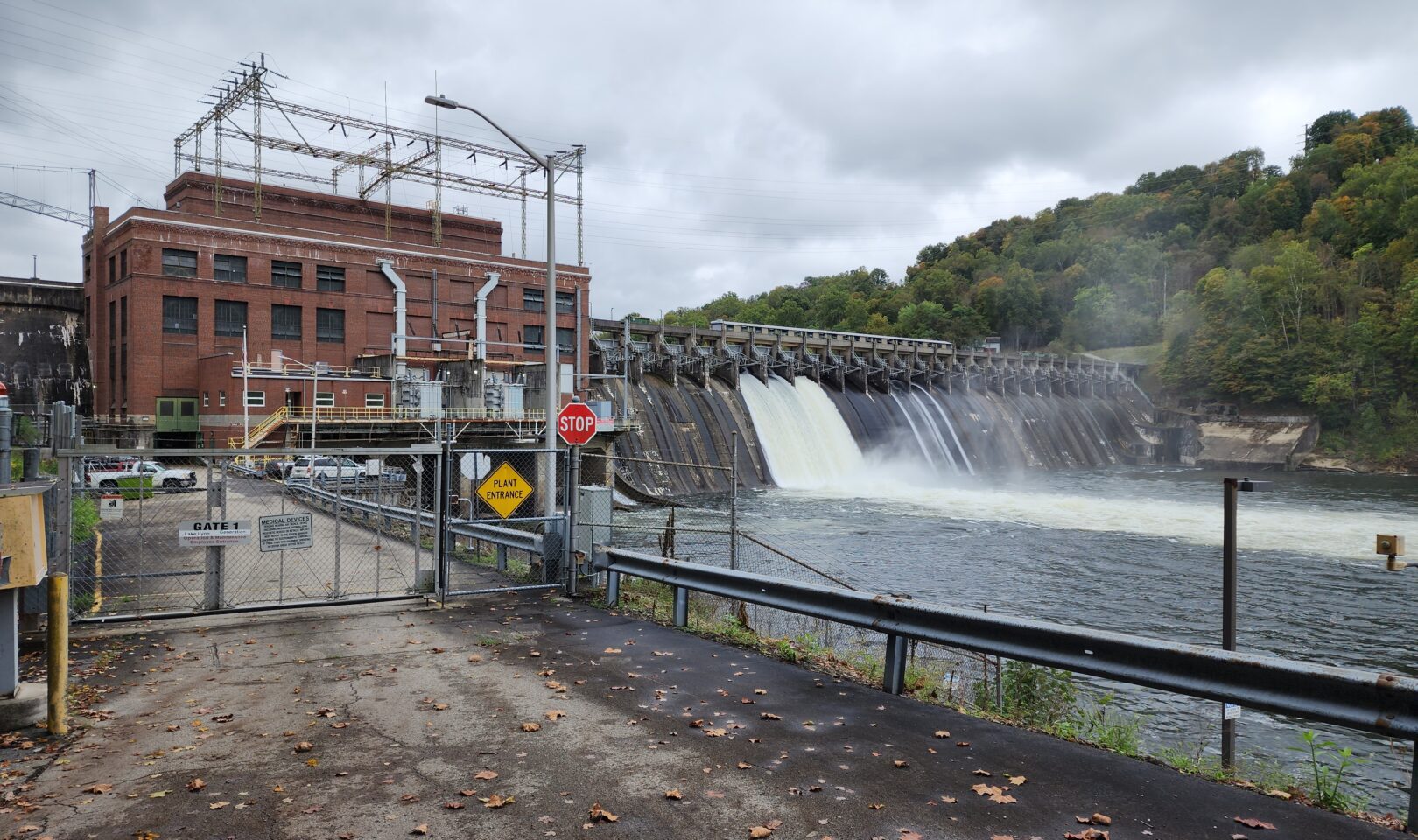
The Federal Energy Regulatory Commission has told lake Lynn Generation that it did not violate its hydroelectric project license when it responded to low dissolved oxygen levels in July, August and October 2024.
The first two instances occurred during the long summer drought and the company responded by opening a dam gate to release more water. The October instance occurred while Lake Lynn was a second generator online to increase power output.
“Based on our review of the available information,” FERC said in a Wednesday letter to the company, “we will not consider the DO deviations included in your July 19, August 14, and October 4, 2024 reports as violations of your project license.”
The July instance occurred on July 16, when the dissolved oxygen dropped below required level (necessary to maintain aquatic life below the dam in the Cheat River) three times for 10 minutes each.
Lake Lynn opened a dam gate to get water flowing and stir up the oxygen levels, and FERC said the company acted according to operating procedures.
Also on July 16, Lake Lynn submitted to FERC a request to lower its seasonal minimal Cheat Lake reservoir level by three feet in order to increase spillway discharge.
That request drew overwhelming negative responses from the community, with residents expressing concerns about the negative effects on boaters and Cheat Lake residents and on the lakeside economy. Many opposition letters cited distrust of the company and echoed allegations of poor maintenance of the lake and its recreational facilities.
The August instance occurred on Aug. 14, with oxygen levels falling below the minimum level twice. Again, Lake Lynn opened a dam gate to get more water flowing. In both the July and August cases, FERC said in its letter, “You state in your report that no adverse environmental or other resource effects were observed or reported as a result of these deviations.”
Lake Lynn withdrew its request to lower the lake level on Sept. 11, 2024, in the face of the overwhelming opposition and West Virginia’s Department of Environmental Protection and Division of Natural Resources withdrawing prior OK’s.
The Dominion Post reported on Sept. 24, 2024 that the effects of the ongoing drought were apparent around Cheat Lake. Marinas were largely empty. Boats were stranded on mud flats. Related in part to the low lake levels, vast swaths of hydrilla covered portions of the lake surface.
As explained before, the summer drought put Lake Lynn in a trilemma – having to choose between three competing FERC license requirements: maintain the summer level of 868-870 feet; maintain a flow rate of 212 cubic feet per second (cfs) into the Cheat River, with an absolute minimum of 100 cfs; and maintain dissolved oxygen at 5 milligrams per liter for the aquatic life.
In withdrawing its request to lower the lake level, Lake Lynn proposed developing an Operation Plan that will include standard operating procedures to be implemented during periods of low inflow and low dissolved oxygen, “which will document the prioritization of license requirements and how Lake Lynn will comply with the operational requirements of the license.”
Whether Lake Lynn had violated its license requirements was a question raised in a lawsuit underway in federal court.
Marina 1 LLC, a Biafora family company doing business as Cheat Lake Marina, filed suit Sept. 30, 2024, alleging that before the Labor Day weekend, Lake Lynn deliberately lowered the level of Cheat Lake below the 868-foot minimum in violation of its Federal Energy Regulatory Commission license. This caused various damages, some of them irreparable.
Both sides are awaiting a decision from Judge Thomas Kleeh in the U.S. District Court for the Northern District of West Virginia in Clarksburg: whether the case might be dismissed; or remanded back to Monongalia County Circuit Court, where it began, and continued there; or neither and simply continue in federal court.
Marina wants the case sent back to county circuit court. Lake Lynn wants it kept in federal court and wants the case dismissed.
The October incidence occurred on Oct. 4, 2024 and was related to stationary water stored in a turbine, Lake Lynn told FERC. When the oxygen level dropped, the company decreased generator output and opened a gate to increase spillway discharge.